An authentic aesthetic
Kintsugi, the poetic art of repairing broken ceramics with gold, is more than a technique—it is a philosophy of life. And at the heart of this philosophy lies the spirit of wabi-sabi, the Japanese aesthetic that honors imperfection, impermanence, and the invisible beauty of time.
To understand Kintsugi, one must first understand the current it flows from. Like a golden river meandering through timeworn stones, Kintsugi draws its essence from wabi-sabi, embracing the cracks not as flaws but as footprints of life.
What does “Wabi-Sabi” mean?
The term wabi-sabi (侘寂) is composed of two kanji, each carrying centuries of layered meaning:
• Wabi (侘) originally evoked loneliness, or the melancholy of a solitary life. Over time, it evolved to describe the quiet beauty of simplicity, the serene appreciation of nature’s modest forms, and the richness of restraint.
• Sabi (寂) refers to the graceful aging of things—the patina of time, the stillness, the beauty of wear and weathering. It is the nobility of the faded, the gentle dignity of decline.
Together, wabi-sabi forms a worldview that celebrates the incomplete, the transient, and the imperfect—offering a gentle resistance to a world obsessed with polish and perfection.
Kintsugi as a Wabi-Sabi Practice
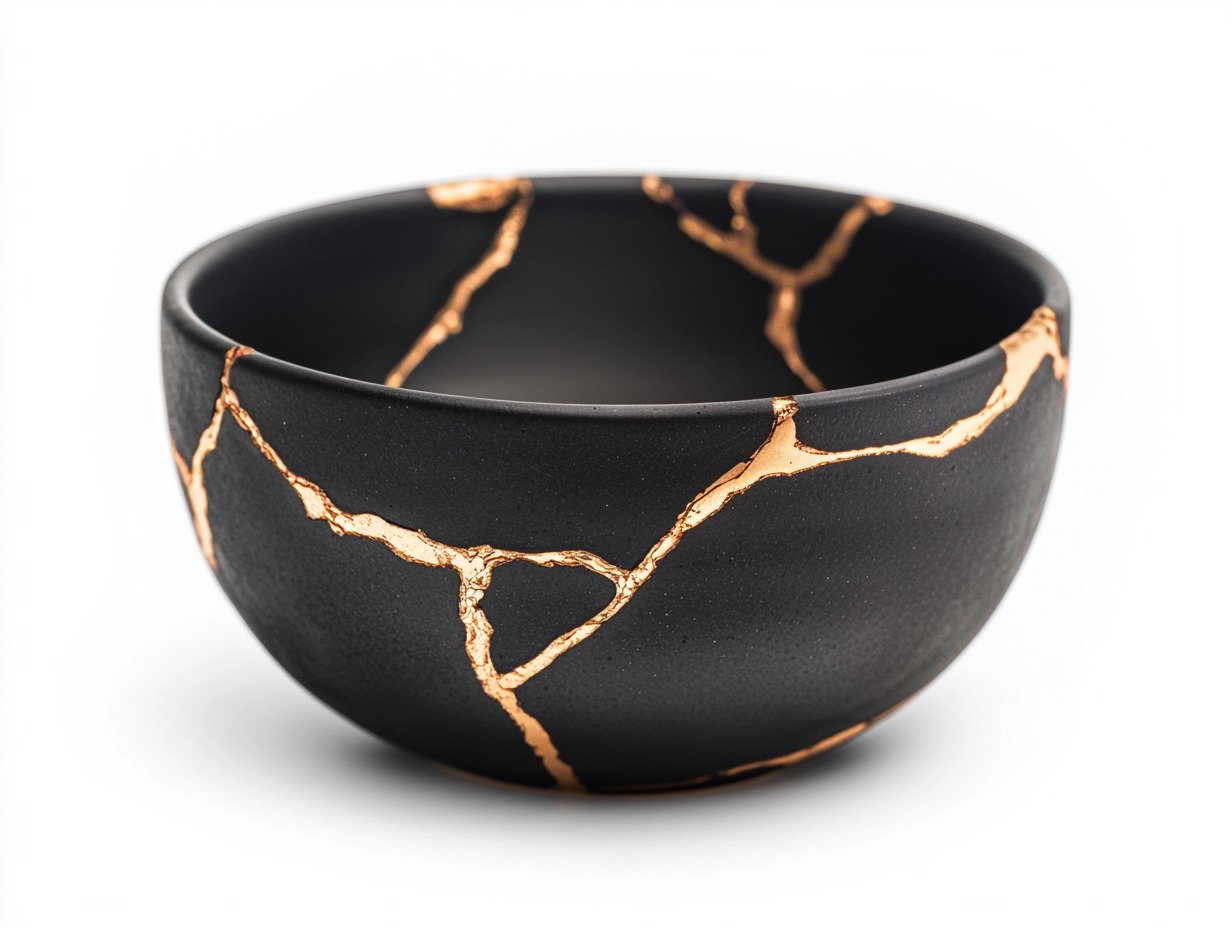
Kintsugi is often seen as a tangible expression of the wabi-sabi mindset. When a bowl breaks, most would discard it. But Kintsugi invites us to look again. Rather than hiding the fracture, it magnifies it. Rather than erasing the damage, it transforms it into meaning. Every seam tells a story. Every repaired object becomes a visual poem of resilience.
A VISUAL POEM
Perfectly imperfect
While Kintsugi is often seen as a pure embodiment of Wabi-Sabi, a closer look reveals a subtle nuance worth exploring—a striking paradox.
At first glance, Kintsugi seems to reflect the Wabi-Sabi spirit in its essence: an embrace of imperfection, timeworn textures, and understated beauty. But while Wabi-Sabi favors simplicity, roughness, and minimal intervention, Kintsugi involves extreme precision, rare materials, and a near-ritualistic dedication to repair. It doesn’t just accept the flaw — it elevates it with gold. Every line is carefully crafted, every detail considered. The result is not rugged or discreet, but luminous and deliberate.
Kintsugi honors imperfection — but through perfection. It embraces brokenness — and transforms it into something extraordinary. Simply, and paradoxically… perfectly imperfect.

Sabi : A Surprising Resonance
Interestingly, the term sabi reappears in the technical vocabulary of Kintsugi—not as a concept this time, but as a substance. In traditional Kintsugi, sabi (錆) is the name of the bonding paste used in the early stages of the repair process. It is made from a mix of water, urushi lacquer, and finely powdered clay or stone.
This sabi paste, whose kanji means “rust” or “oxidation,” holds broken pieces together with its coarse, earthy texture. Though it is not the same character as the sabi of wabi-sabi, their symbolic fields overlap: both evoke aging, imperfection, and transformation.
While these two terms have distinct etymologies and kanji, their poetic correspondence is striking. One describes a worldview; the other, a material. But both reflect a reverence for what is weathered, incomplete, and quietly beautiful.
The beauty of resilience
Both wabi-sabi and Kintsugi teach us to shift our gaze—to see the poetry in a scar, the nobility in what’s been worn. They are not merely artistic trends, but invitations to live differently. To slow down. To cherish the marks of time. To accept that beauty is not always born in symmetry or gloss, but often in fracture, repair, and the grace of imperfection.
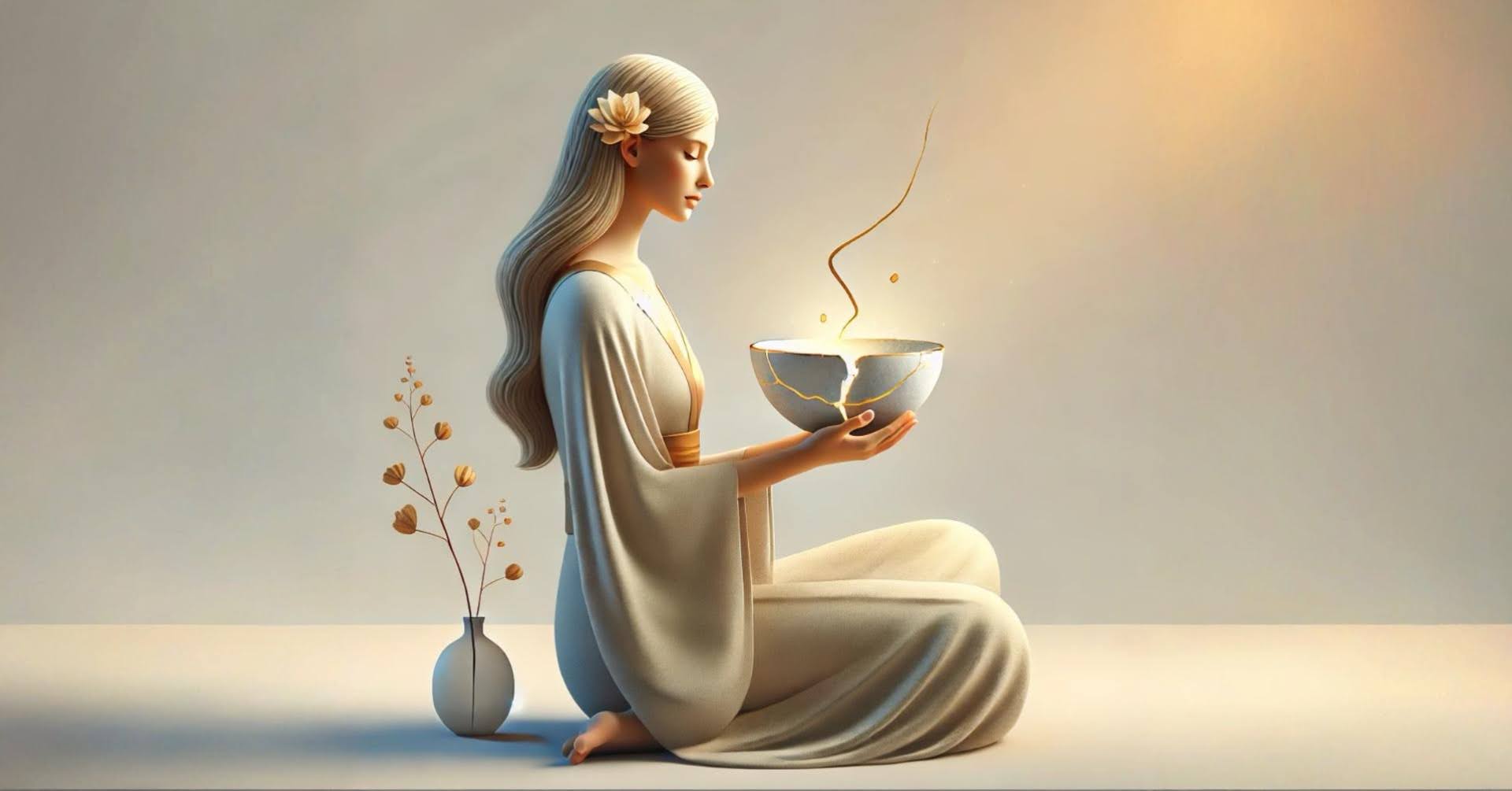
In this way, Kintsugi becomes not just an art form, but a lived metaphor for healing and resilience.

Embrace the strength in your imperfection
If the philosophy of Wabi Sabi resonates with you and the beauty of Kintsugi speaks to your soul, it may be time to explore further. You may start by exploring the resources in this directory and, if you feel called, consider the possibility of a spiritual Kintsugi coaching or workshop. We are here to guide you in embracing your own beautiful imperfection and finding strength in it—you too are perfectly imperfect.