What is Resilience? The Art of Rebuilding Ourselves
The concept of resilience
Resilience is first and foremost a concept from physics: it defines the ability of a material to return to its original shape after a shock or deformation. In psychology, this concept has evolved to describe our capacity to recover from hardships, trauma, or failure, and to rebuild ourselves—sometimes even stronger than before. Unlike resilience in physics, healing is not about returning to who we were before—it is about transforming into something even more meaningful.
What does not kill me…
French psychiatrist Boris Cyrulnik, who popularized the idea of psychological resilience, described it as “the art of navigating through torrents.” It is not about erasing suffering, but about transforming it into a source of strength and growth. As Nietzsche famously said, “What does not kill me makes me stronger.” But how does this relate to Kintsugi?
“Resilience means holding on to your dreams, choosing your happiness despite your distress—it’s an act of inner resistance” —Ryadh Sallem, Paralympic champion

Kintsugi – The Japanese Art of Golden Repair
What is kintsugi?
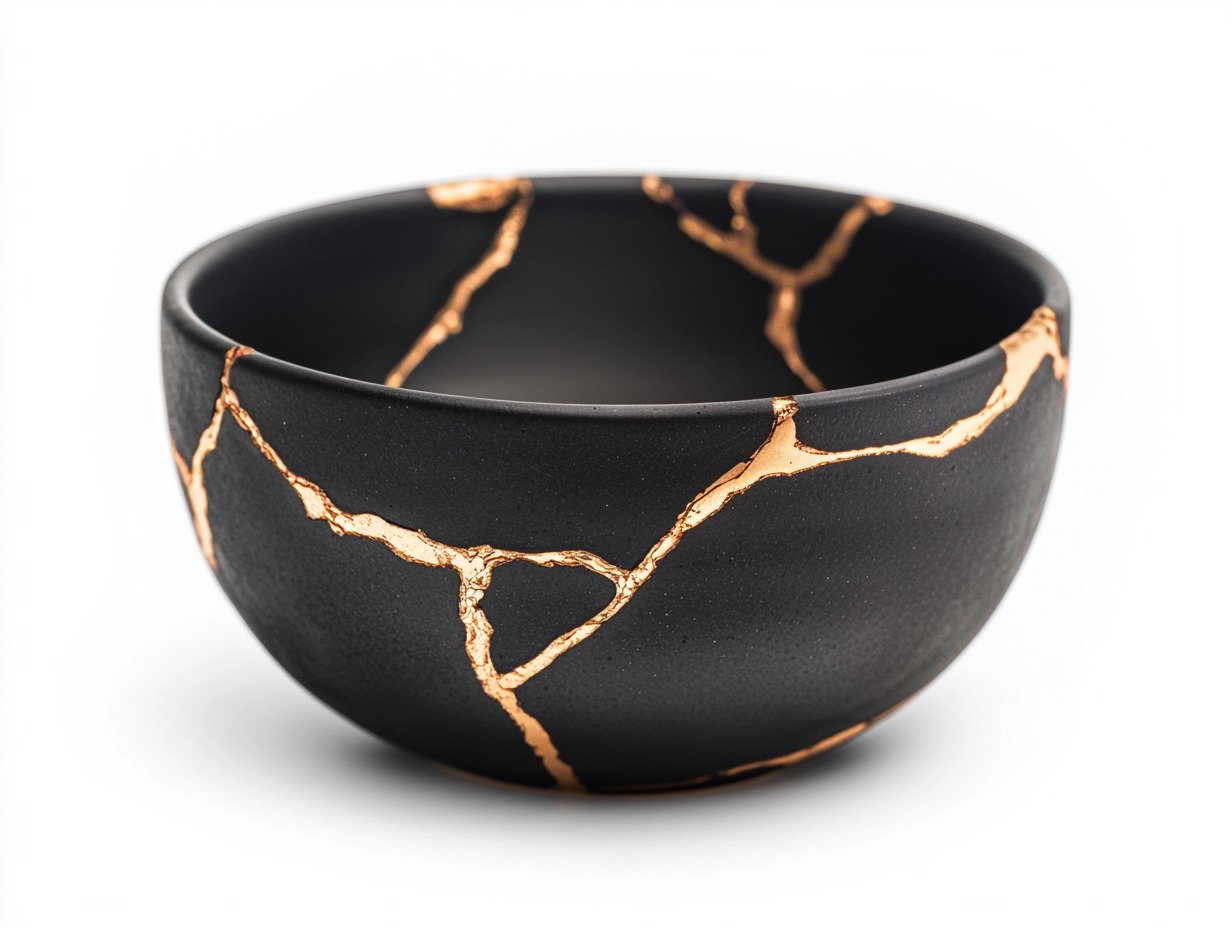
Kintsugi, meaning “golden joinery” in Japanese, is an ancient technique that repairs broken pottery with lacquer mixed with powdered gold. Instead of concealing the cracks, this art celebrates them, transforming fractures into luminous seams. The broken object is not only restored but made more beautiful, more valuable, and unique.
Kintsugi, the art of resilience
More than a repair method, Kintsugi embodies a philosophy of life: it teaches us to embrace imperfection (wabi-sabi) and to see our scars not as flaws, but as part of our personal history. But beyond its obvious beauty, Kintsugi is also a striking metaphor for resilience.
Kintsugi and Resilience: The Strength in Our Cracks
Stronger for having been broken
Just like the golden seams in Kintsugi, our wounds do not make us weaker—they become the very foundation of our strength. When an object is repaired with the Kintsugi technique, the lacquer used to bind the pieces together strengthens over time. Similarly, our painful experiences, once integrated, shape our wisdom, empathy, and inner power.
Honoring the cracks
A piece repaired through Kintsugi does not hide its past; it honors it. In the same way, resilience is not about denying pain but about allowing it to shape us into something stronger, wiser, and even more radiant.
Real-Life Stories of Resilience: From Trauma to Transformation
My Own Kintsugi Story
First, let me introduce myself. I’m Celine Santini—author, coach, and speaker, specialized in resilience.
Break. Mend. Shine. That’s the story of my life. Like many of us, I’ve been through my share of trauma:
two divorces—both when my children were just six months old—and the devastating loss of my mother to suicide. Each event left me shattered, unsure how to move forward. And yet, those very fractures led me onto an unexpected path—the path of personal growth, writing, and, ultimately, a quiet epiphany when I came across the art of Kintsugi.

Would I have become who I am today without these hardships? Probably not. In fact, my book Kintsugi: Finding Strength in Imperfection is dedicated “To my two wonderful ex-husbands, without whom this book would never have existed.” Paradoxically, my cracks have become my blessings : they did not break me—they shaped me. Kintsugi helped me transform my pain into purpose, turning grief into gold. I ‘m a Kintsugirl.
turning grief into gold
Stories of resilience
Through my resilience retreats and kintsugi healing coaching, I have met extraordinary people who, despite immense suffering, have transformed their pain into a source of light for others. For example :
- A woman who, after losing a child, now dedicates her life to supporting grieving parents.
- A man who, following a life-altering accident, became a mentor for those facing physical disabilities.
- A survivor of domestic violence who now helps others rebuild their self-worth.
These individuals, just like Kintsugi pieces, are not defined by their breaks and traumas but by their reconstruction.
Your own Kintsugi Journey
Embrace the calling of Kintsugi
You are not broken—You are becoming. Whether through reading, contemplating, or practicing Kintsugi, allow this philosophy to guide you through life’s challenges. If, when you first saw a Kintsugi piece, you felt a deep recognition – « This is me ! » – then the silent calling of Kintsugi is speaking to you, inviting you to embrace its wisdom.
Read More About Kintsugi and Resilience
If you want to dive deeper into this powerful metaphor, explore the international award-winning book Kintsugi: Finding Strength in Imperfection. This book guides you through the philosophy of golden repair and how it can be applied to your own healing journey.
Keeping the Kintsugi Image in Your Heart
Resilience is not a one-time achievement—it is a continuous process. We will all be broken again. Kintsugi whispers a silent wisdom. If we integrate the image of Kintsugi deep within us, we can hold onto the certainty that we will rebuild. Next time life shatters you, remember: you have already survived 100% of your worst days. The cracks may hurt now, but one day, they will shine with gold.
Experience Kintsugi First-Hand
What if you tried to experience Kintsugi beyond words ? In our Kintsugi directory, you’ll find worlwide resources to experience kintsugi, whether at home with a kintsugi kit, in a hands-on initiation session, a kintsugi healing workshop or a private one-on-one session. You will discover how your own journey mirrors the beauty of golden repair.
Start Your Own Kintsugi Story
A unique Kintsugi 6-step method
You don’t have to go through this alone. Kintsugi is not just a repair—it’s a reconnection. Our own Resilience Kintsugi programs go far beyond the traditional repair of broken pottery. Yes, you will create your own Kintsugi piece, but the process is designed to be much deeper, more immersive, and profoundly transformational.
Unlike a traditional Kintsugi workshop or coaching, which focuses solely on the technical restoration of an object, our 6 -step Kintsugi approach integrates:
- Personal growth & introspection – Guided exercises that help you reflect on your own life journey, embracing your past wounds as part of your unique story
- The 6-step Kintsugi method – A structured process that mirrors life’s transformative path, allowing you to acknowledge, heal, and redefine yourself
- Art therapy & symbolic transformation – Each fragment of your broken piece represents a part of your story, and through the act of repairing, you symbolically magnify your past traumas with gold, honoring their role in your evolution
- A deep connection with your Kintsugi piece – Your final artwork is not just a repaired object, but a personal talisman—a reminder of your resilience and growth, embodying the energy of your healing journey
- Psychomagic & ritual integration – The process is completed with a guided meditation, helping you integrate the Kintsugi spirit into your being, so that the transformation extends beyond the object itself

Because there’s always a golden lining
This is not just an art workshop or just another coaching session—it is a healing experience, an act of self-reconstruction and empowerment. Your Kintsugi piece becomes a mirror of your inner journey, a physical manifestation of your strength, and a daily reminder thatyour scars are not flaws, but golden paths to a new beginning.
Why connect Kintsugi and resilience?
Because resilience is not about erasing pain, but learning how to live with it. Kintsugi gives a tangible image of this process, where scars remain visible and meaningful.
Does Kintsugi idealise suffering?
No. It does not glorify pain. It simply acknowledges that certain wounds are part of life and can become points of support rather than sources of shame.
How is this approach different from classic resilience narratives?
It relies on gesture, matter and silence rather than motivation or theory. Experience comes before explanation.
Can we speak of healing through Kintsugi?
More of transformation. Kintsugi does not promise a return to the original state, but a new balance that includes what has been lived.
Why does this perspective touch so many people?
Because it puts simple words on universal experiences, offering a calm and honest way to approach resilience without pressure or performance.
Is Kintsugi only for extreme hardship?
No. It also applies to transitions, symbolic losses, changes of direction and moments when life needs to be reassembled differently.